Wednesday, February 3, 2016

Chocolate Chia Seed Pudding

Adapted from a recipe by Dr.Libby

Place all ingredients for cashew milk (below) into your blender (a high speed blender gives the best results):

1 cup raw cashew nuts. (Can also use 1 cup soaked almonds)
2 cups water (good filtered water without the additives)
Sweetener - 2 tablespoons maple syrup or rice syrup or date puree
the seeds of 1 vanilla bean or 1/4 tsp vanilla paste or vanilla essence
2 Tbsp cacao powder
Small pinch salt

Now blend until smooth and creamy. Place the blended chocolate cashew milk into a bowl.


Add the white or black Chia Seeds to the cashew milk. Stir in with a whisk.
Leave to set in the fridge. The longer this sits, the firmer it becomes. Less seeds results in a more liquid pudding.

Serve in decorative glasses or jars. Add fruit and sliced almonds to decorate.


You can find many other delicious recipes using Chia Seeds. Check out Recipes Hubs here.


Mango Chia + Rhubarb Chia

Did you know that:
  • If you run out of eggs or if you’re making a vegan recipe, you can mix 1Tbsp Chia Seeds with 3 Tbsp water, let the mix sit to create a gel and then substitute it in for eggs in your baking.
  • Chia is actually in the mint family and is native to parts of Mexico and Guatemala.
  • You shouldn’t eat more than a few seeds without water.  There is a danger that taking, say a tablespoon of seeds and crunching them up in your mouth without having previously soaked them in water, can cause a serious blockage in your inner piping!  But seriously, who would do that?

Chia Seeds - not just another trendy super-food

You might be thinking, “Here we go, another health food trend.” And you’re right... well, not exactly. Not all trendy “super-foods” are really super, but I’d say that Chia Seeds most definitely are! 

Why are Chia Seeds so good?

Chia Seeds are high in protein and fibre, packed full of many nutrients and have a very low carbohydrate content. If you want some more nutrition info, click here.

28 grams (about two tablespoons) of Chia seed contains:

High calcium - in fact, 18% of our daily calcium needs. Calcium, magnesium, phosphorous and protein are important for bone health as we age.

High protein - 4 grams of protein in 28 grams of seed. That’s about 14% of our daily need, which is high for plant material. This protein is also called high quality protein because it contains many of the amino acids required to make protein in our bodies.

High fibre - 42% of your daily need – just under 1 tablespoon of fibre in 2 tablespoons of seed.  This is what allows chia seeds to absorb 10 – 12 times their weight in water. They become like a gel when soaked, theoretically making your stomach feel full which is why they feature in the weight loss category.

Good amounts of Magnesium, Manganese, Zinc, Vitamin B3 (Niacin), Potassium, Vitamin B1 (Thiamine) and Vitamin B2, Phosphorous.

Very good antioxidant levels – have a read of some current research here.

High in Omega-3 fatty acid ALA – However, our human digestive system is not as efficient in converting this plant source Omega 3 for use in the body as it is at using the Omega 3’s found in fatty fish.


7 Ways to use Chia Seeds

  • Sports drinks - Chia seeds can improve sports performance as much as a sports drink can. Some people include chia seeds with their sports drink or just add them in their water bottles to drink as they run (you don’t necessarily have to chew these seeds to absorb their ingredients).
  • In smoothies – add 1 or 2 tablespoons to your ingredients. Stir in at the end.
  • Sprinkle on your morning cereal, yoghurt, or fruit for a crunch.
  • Add to baking – in energy seed bars, muffins, or on top of bread. 
  • Mix into pancakes, stir fries, and lentil casserole.
  • Make coatings for fish and tofu using egg whites, whole grains, flavouring spices and chia seeds.
  • Chia puddings for breakfast or dinner - chocolate, mango, pecan, rhubarb, raspberry are all popular flavours. Check out our Chocolate & Chia Seed Pudding recipe here!

Wednesday, January 27, 2016

Easy-Peasy Pocket Bread Recipe

***

Lebanese Pocket Bread


This recipe makes 8 pocket breads

3 tsp dried yeast
1 tsp honey
1 cup lukewarm water
1 Tbsp oil (good olive oil)
½ tsp sea salt, sprinkled on top of bread not mixed into dough
Flour for rolling out
Butter or baking paper for tray

1) Put all the water, dried yeast, and honey into a large bowl.  Mix well. Do not add any salt to the mix yet.
2 & 3) Add oil, stir again.
4) Add flour.


5) Stir.
6) Then knead with your hands. This can take between 5 and 10 minutes. Dip your kneading hand into a bowl of cold water before you start and periodically throughout. This will help keep the dough from sticking to your hand. Form the dough into a rounded lump and let it rise for 20 – 30 minutes.
Pre-heat your oven to 250 degrees C while the dough is rising.
7) I actually let it over-rise here. The dough is better if its surface is actually rounded not flat.
8) Now knead the dough for 3 or 4 minutes.  


9) Form it into a sausage shape.  Lay it on the floured bench and cut into 8 even-sized pieces. I made double recipe here so I’ve cut it into 16 pieces.  
10) Roll or shape each piece into a circle.  Make the top surface of the bread smooth*   
11) Transfer to the buttered baking tray and let the pocket breads rise for about 15 minutes. Now it’s time to use the salt. Generously sprinkle salt evenly over each bread.  
12) Bake in the top half of a very hot oven (250 degrees C) for 5 minutes or until the breads puff up.  As soon as they’re slightly brown take them out and cool on a rack.


13) Done.  
14) Now all you have to do is clean up!  
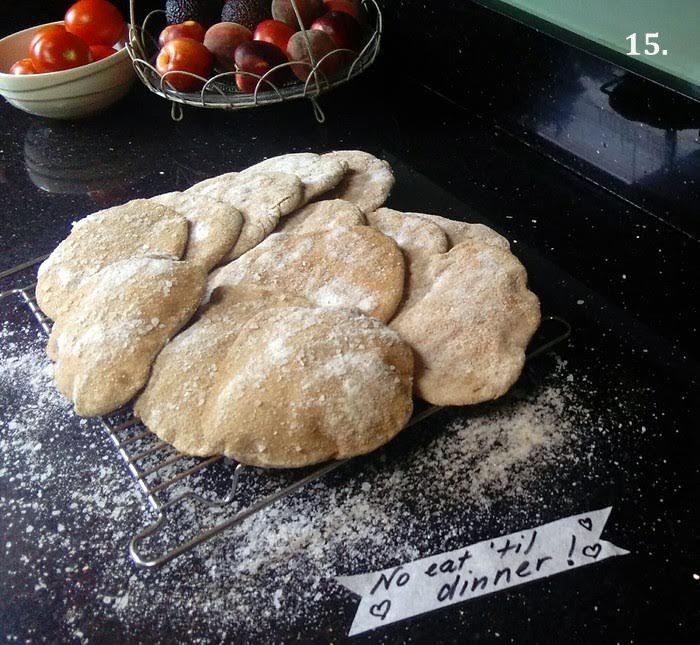
15) Mouthwatering to eat straight away.


A couple of notes:

Sometimes pockets in the bread are not formed. However the bread is still very nice anyway. Three reasons why pockets may not have formed in your bread: 1) The bread is not totally smooth on the top surface but has some cracks in it* 2) Not enough salt on top 3) The oven is not hot enough.

Eat fresh from the oven for best taste! 


Recipe shared with permission from Karin Putner, nutrition consultant.

***

Thursday, January 21, 2016

Roses are red, Violets are blue, Sugar is sweet...

Coming into the New Year we're starting to think how we can replace those cravings for Christmas mince pies and Lindt chocolate we acquired over the holidays... It might help to first have some knowledge about that very ingredient we're so addicted to. SUGAR.

-----------


“Roses are Red, Violets are Blue, Sugar is Sweet and it’s killing you!”

At least this is what the nutritional tabloids would have us believe. It seems that if you want publicity in today’s health market, all you have to do is point an accusatory finger at those sweet little crystals which are being blamed for the current health crisis. Despite my firmly held belief that we should be minimising our consumption of this addictive ingredient, I am usually suspicious of hype. So I have been following with wary interest the various claims that are currently circulating regarding the forms and amounts of sugar that we should (or should not) be consuming. It can be overwhelming and often confusing to make sense of the myriad of articles, research, and sometimes unfounded nonsense being conveyed about sugar.

Enter, ‘That Sugar Film’ http://thatsugarfilm.vhx.tv : a humorous and down-to-earth look at the effects of our apparently disastrous dependence on sugar. The documentary follows Damon Gameau’s experiment on himself, in which he spends two months consuming the current estimated daily intake of sugar in Australia. The alarming thing is where Damon gets all that sugar from. Contrary to common belief about the main contributors to our sugar-laden diet, he consciously shuns all soft drinks, candy and ice-cream in favour of what are considered “healthy” options. For two months he eats the equivalent of forty teaspoons of sugar per day, through foods like cereal, fruit juice, yogurt, and various other ‘low-fat’ options. He also joins in the modern hype of juicing – a supposedly healthy choice which, in actual fact, leads to downing the sugar from more fruit than you could ever eat whole in one sitting (minus the good fibre).

The impact on Damon’s previously healthy body (from a very low sugar diet based on whole foods) is dramatic and swift. His health is monitored by a doctor, pathologist, nutritionist and even psychologist who are all amazed at the effects in such a short time.  As well as fatty liver syndrome, pre-diabetes, increased blood pressure and an 8 kilogram weight gain, he suffers mood swings, brain fogginess and constant lethargy. Because of the constant ‘hits’ of sugar he is getting which cause temporary highs followed by major slumps in energy, he notices an ever-present craving for more sugar laden foods so that his brain can receive its next burst of fuel – a vicious cycle. Thankfully, as noted in the conclusion, all the effects on his poor body are reversible and, with the experiment over, he returns to his normal healthy state through whole, natural foods.

Well worth watching, ‘That Sugar Film’ highlights the widespread misunderstanding around sources of sugar and exposes its more subtle hiding places. To me, it was a reminder about the responsibility we must all take for our own health, and the importance of being well informed consumers.  That sweet, and slightly sinister, stuff we know as sugar has such an impact on our health that it probably deserves all the limelight it has been getting. Though we may be sick of hearing stern admonitions about our sugar consumption, it seems we will be worse off if we do not take heed. ‘That Sugar Film’, through one man’s drastic experimental measures, aims to raise a red flag of caution to all who may think that the sugar debate is simply another melodramatic act trying to get attention in an overcrowded health scene.


“Roses are Red, Violets are Blue, Sugar is Sweet, So beware what you chew!


About the Author: Tessa McGeorge has a great interest in people and in healthy living.  She has a degree in counselling and is currently studying for a degree in nutrition science.  She enjoys writing from her own experiences with healthy living and likes to base her conclusions in scientific research.


For some excellent (and delicious) ideas on how to replace the sugar in your diet and avoid the cravings, check out the famous I Quit Sugar blog! Many of the ingredients mentioned can be found at happyhealthy.co.nz

Remember, not fanatical, just wise!

Wednesday, December 9, 2015

Christmas Recipes - Grandma's Fruit Mince Pies!

As a time-honoured tradition, our family have always prepared, created, and consumed more than a hundred mince pies at Christmas time. Sometimes, our grown-up children are more excited about the pies than the presents!

Everyone loves my mother's recipe. The pastry is divine, the fruit mince not too sweet but sweet enough, and the whole pie the perfect size. Because Christmas is all about sharing joy, we thought that we'd share the joy of my mother's famous mince pie recipe! And the best part - all the key ingredients can be bought off the Happy & Healthy website.

Change your Christmas cooking one step at a time with this delightful recipe... and no, it's not a raw mince pie recipe, nor is the sugar replaced by stevia, but remember "wise, not fanatical". Let's call this our cheat day... umm, month.

Remember: Make this fruit mince at least 1 day before you want to bake your Christmas Mince Pies. Any pastry recipe will do - we recommend something that isn't too sweet (you can add a dusting of icing sugar at the end). I'm getting hungry just typing out this recipe...

---------------------------------------------------------------------------------------------------------------------------------------------------------

* Christmas Fruit Mince *

...for Grandma's Christmas Mince Pies


Makes three large jars and will keep in the fridge for weeks; months if it has brandy in it. Make this (at least) the day before you want to bake so it has had time to 'set' in the fridge.

1 kg fruit - make up a mix of raisins, sultanas currants, dates (can be bought here)
2 cups water
250 g butter
1 tsp cinnamon (can be bought here)
1 tsp mixed spice (can be bought here)
1 Tbs marmalade
2 Tbs golden syrup or maple syrup (can be bought here)
1/2 cup brown sugar
1 Tbs brandy (optional - added after cooking)

Place all together in a saucepan and bring to the boil while stirring. Simmer for 10 minutes. It will thicken. Stir.

Allow to cool. Add 1 tablespoon brandy if you like and store in glass jars in the fridge. Cool overnight before using.


Enjoy!


Sunday, April 12, 2015

Cholesterol: Part Two "If Cholesterol is not the Enemy, What is?"


Like you I’m trying to find out more about healthful living without being fanatical.  I’m not a medical professional, but I have do have a science background in my training and have had a long-standing interest in nutrition and health.

There’s some challenging research work being done here in New Zealand (and overseas) that indicates “it is likely that the low-fat diet approaches and lipid hypothesis perpetuated over the last several decades may have caused more harm than good.”1 AUT video clip 2  
 
Is it true that we should be feeding ourselves and our families with a low-fat diet to prevent us from having high cholesterol and consequent heart disease in the long term?

I’m drawing from this research and from my own review of the book The Great Cholesterol Myth
3 authored by nutritionist J. Bowden Ph.D and cardiologist S. Sinatra M.D (published in 2012 and available in your library or at Book Depository).  This book is worth reading if you are concerned about heart disease or diabetes.  It is well laid out and I found it reasonably simple to read.4

If you’ve ever had a blood test for cholesterol5 in NZ or Australia you will probably have been told that the LDL (Low Density Lipoprotein) is the baddie and HDL (High Density Lipoprotein) is the goodie. If the test showed you had more than 2.0 millimoles per litre of LDL in your blood a low-fat diet would have been recommended to you in order to reduce the bad cholesterol.

You may remember from last week’s article that it’s not actually the cholesterol that’s the problem it’s the “boat.”  Think of cholesterol as the cargo that’s carried along on protein “boats” called HDL or LDL.  Based on more recent research the concept of LDL = bad and HDL = good is outdated. More about why the boat can cause a problem in a moment.

Okay, back to the question we all want the answer for:

If cholesterol doesn’t cause heart disease what does?
Answer: Inflammation

There are two types of inflammation we experience in our bodies. 

1. We’re all familiar with inflammation that occurs when we get a cut on our skin.  This is called acute inflammation and it hurts. Immune cells rush to mend the injured area.

2. Chronic inflammation within the body can lie undetected, as pain is not evident. It is characteristic of many diseases like arthritis, cancer, kidney and liver disease and cardiovascular disease.

So what is the enemy and how does chronic inflammation happen?

1. Chronic inflammation is begun by damage done to LDL “boats” by free radicals - the enemy! This damage is called oxidation. Think of the browning that happens to a cut apple sitting on your plate for a while. That’s oxidation happening.

2. Damaged (oxidised) LDL “boats” carrying cholesterol can stick to the lining of the artery wall. This delicate and sensitive, innermost layer of the wall of our arteries is called the endothelium and is only one cell thick.

3. This attaching of the oxidised, cholesterol-carrying LDL boat triggers the immune system into action and ultimately causes inflammation that begins the process of atherosclerosis in the thin wall of the artery.

It’s not the cholesterol; it’s the damage done to the “boat” that’s the problem!
Let’s stick with the picture of the boats carrying the cargo.  LDL (Low Density Lipoprotein) “boats” deliver cholesterol to the cells that need it for things like production of hormones, brain cells, for fighting infection…and so on.  The HDL (High Density Lipoprotein) “boats” remove the excess cholesterol if it’s not needed.

If the LDL boat and its cargo become oxidised and then attached to the endothelium the process of inflammation begins as cells from the immune system arrive to take care of the invader.  Plaque will then form at the damaged site. This pocket of plaque can in time rupture causing blood clots which can block the flow of blood to the heart resulting in a heart attack.

Not all LDL “boats” can turn bad when damaged through oxidation.  New technology has identified several types of LDL, for example LDL pattern A and LDL pattern B.

LDL pattern A is large and fluffy in structure compared with LDL pattern B which is dense, hard and is most likely to be damaged by oxidation. We all have both these types of LDL in our bodies, but some people seem to have higher levels of one or the other.  Both types are good, but pattern B is easily oxidised by free radicals and then becomes a problem.

There is advanced blood testing available today that can measure these new particles which are a better indicator of potential heart disease than our current tests.  However this is not yet available in NZ; you would need to ask your doctor to send a sample of blood offshore for this advanced testing.6

It would be useful to know some healthful practices that would minimise free radicals and prevent oxidation of these LDL cholesterols and consequent inflammation of our artery inner walls wouldn’t it?

What can we do about minimising the damage done by free radicals?
We can eat more foods high in antioxidants that deal to the free radicals in our bodies, for example fresh fruit & veges, whole foods, raw cacao, etc…  (more to come about this in a subsequent newsletter/blog).  We need to avoid consumption of substances that create free radicals - stop smoking, check our intake of heavy metals, be aware of insecticides, toxins in the air, additives in the food supply and highly processed foods, all of which all contribute to oxidation damage in our bodies.

Let’s take care of our overall health - minimise and manage stress, exercise, be grateful, be compassionate, work to be happy (as they say “a cheerful heart is a good medicine”), and make time to enjoy our friends and family more.

BUT… oxidation caused by free radicals is only one of the conditions that cause inflammation, another is … sugar!  It appears that “this food is a far greater danger to our overall health than fat ever was.”7

Bibliography
1. http://www.aut.ac.nz/profiles/grant-schofield I first started becoming interested in this topic when I read a research article about high fat/low carb sports nutrition published by AUT (Auckland University of Technology) last year under the supervision of Dr. Grant Schofield, Professor of Public Health, and Director of the Human Potential Centre at AUT.
2. Fast Fwd this video clip about 5 minutes to lose the intro and the talk about the restrooms etc!  http://www.humanpotentialcentre.aut.ac.nz/
3. Where to buy
The Great Cholesterol Myth http://www.bookdepository.com/Great-Cholesterol-Myth-PhD-Jonny-Bowden/9781592335213
4. Comments on the Framingham Heart Study 1948-1964, on which many of the public health guidelines about cholesterol have been made: https://thescienceofnutrition.files.wordpress.com/2014/08/concerning-the-possibility-of-a-nut.pdf
5. Blood testing in NZ https://www.southerncross.co.nz/AboutTheGroup/HealthResources/MedicalLibrary/tabid/178/vw/1/ItemID/156/High-blood-cholesterol-levels.aspx#types
6. NMR test, the Lipoprotein Particle Profile Test (LLP), the Vertical Auto Profile Test (VAT), are some of the advanced blood tests available, but not in NZ currently.
This site makes mention of the various blood tests done in NZ.  http://www.bpac.org.nz/resources/campaign/cardiovascular/lab_cardio.asp?page=14
Dr Bill Reeder: Advanced blood testing & where to get it done http://www.medcom.co.nz/?page_id=188
7. J. Bowden Ph.D and S. Sinatra M.D,
The Great Cholesterol Myth: Why lowering your cholesterol won’t prevent heart disease – and a statin free plan that will.  Fair Winds Press, MA, USA. p 54.

Cholesterol: Part One "This Cargo Needs a Boat"

When Rodney asked me to write an article about cholesterol I began to think about why we want to understand this topic. Well, it’s all about heart disease and our doctors telling us to avoid high-cholesterol foods, isn't it?

Okay, I’m interested to investigate this because I don’t know much about it myself, apart from the fact that I went to the doctor some time ago, with someone I know and love, for a test.  She received her results from her blood test that showed she had higher than normal LDL cholesterol levels.

I’m also interested in nutrition and health so I’m looking at this topic from that angle.  Does the food we eat affect our cholesterol levels?

I will endeavour to explain cholesterol in a simple way that even I can understand. If you’re a medical professional reading this please forgive me for oversimplifying the hugely complex processes within our bodies.

I hope I can do justice to this topic and make it as accurate as possible.


What does the term heart disease actually mean?
Atherosclerosis is the technical term for what results in heart disease.  Cholesterol filled constructions, that we call plaque, gather along the walls of the arteries and cause an obstruction to blood flow.

The deposited plaque gets larger and denser which in turn causes inflammation of cells and various types of tissue damage.

In time these plaque constructions can rupture causing blood clots in the artery.  A blood clot can block the flow of blood to the heart which deprives the heart of oxygen.  This causes part of the heart muscle to die and is what we call a heart attack.  Worldwide, this disease is the most common cause of death1.

So trying to understand how this disease is caused becomes extremely important as we may be able to prevent it in ourselves.


What is Cholesterol?   
Cholesterol is a sterol made by the animal kingdom, as opposed to a phytosterol made by the plant kingdom. It is a molecule made up of carbon, oxygen and hydrogen.

We have been told that there is good and bad cholesterol.  The truth is cholesterol is essential “for life” and therefore good.

The body uses cholesterol for hormone production – the steroid hormones like testosterone and oestrogen; it helps make Vitamin D, it’s used in the wall structure of nearly every cell.  The brain is rich in cholesterol and accounts for about a quarter of all the cholesterol in our bodies2.   Without cholesterol our cells would not operate properly.
  
Where Do we Get Cholesterol From?
About 85% of the total cholesterol in our bodies is actually manufactured within nearly every cell of our bodies.  Only 15% is obtained from the food we eat.

You can visualise this if you imagine a swimming pool being filled from two sources; a fireman’s hose and a small garden hose gently streaming into the pool.  Our bodies mainly comprise cholesterol that we have synthesized ourselves (fireman’s hose) and not so much the cholesterol we have consumed in our daily food (garden hose).


Total cholesterol in the blood (serum cholesterol) is what is measured if you have a blood test for cholesterol.  But is this measure a reliable indicator of possible heart disease?

Heart Disease only Happens if Cholesterol Finds its Way into the Artery Wall       
According to Peter Attia MD, “Heart disease does not happen without cholesterol finding its way into the artery wall.”3  You could have a look at this YouTube clip4 if you want much more in-depth information.

What Gets Cholesterols into the Artery wall?  
Dr Attia describes how this happens.  If we liken the veins and arteries to a canal system within the body then there are boats plying their way up and down the river delivering and collecting cargo at various docks along the way.  


 When we talk about cholesterol (LDL or HDL) relating to heart disease we’re not really talking about cholesterol itself.  We’re talking about the boats, Low Density Lipoprotein (LDL) and High Density Lipoproteins (HDL).  Cholesterol is the cargo.  The cargo needs a boat to take it to the correct docking point along the river. The boat is the lipoprotein.


Is Having a Lot of Cholesterol in Your Bloodstream a Bad Thing?  According to the site Authority Nutrition   “Having a lot of cholesterol in your bloodstream is NOT a bad thing5, unless this cholesterol is being carried around in the wrong lipoproteins (ie. the wrong boats).

Heart disease is not a cholesterol derived disease; it is driven by the lipoproteins that carry the cholesterol around.  Current evidence shows that cholesterol is not the enemy.”


Bibliography:
1. Most common cause of death   http://www.cdc.gov/nchs/fastats/leading-causes-of-death.htm
2. The Great Cholesterol Myth, J. Bowden Ph.D, S. Sinatra M.D., Fair winds Press, 2012
3. What is cholesterol?  http://eatingacademy.com/nutrition/the-straight-dope-on-cholesterol-part-i
4. Dr Peter Attia YouTube clip  https://www.youtube.com/watch?v=dAWdHYSrh7M
5. Authority Nutrition http://authoritynutrition.com/diet-cholesterol-and-lipoproteins-explained/